The Honest Answer Up Front
Tree removal cost is one of those questions where every answer online seems designed to dodge you. So here is the straight version. Across the industry nationally, removing a tree runs anywhere from about $200 for a small ornamental to $5,000+ for a huge or hazardous removal, and the majority of everyday jobs land somewhere in the wide middle of that spread. Small trees tend to fall around $200 to $600+, mid-size trees around $600 to $1,500+, and large or difficult trees around $1,500 to $5,000+.
One important caveat before you take any of those numbers to the bank: they are national ballpark figures, not quotes. Every tree, every yard, and every job differs, and the only price that means anything for your property is the one a crew gives you after standing under the actual tree. Use the ranges to spot estimates that are wildly out of line in either direction, nothing more.
What is worth understanding is not the number itself but why the number moves. Once you know that, every estimate you get will make sense.
The Five Things That Actually Move the Number
When someone asks how much it costs to cut down a tree, an estimator is quietly scoring five things:
- Size. Height and trunk diameter drive everything. A 30-foot dogwood is an afternoon. An 80-foot oak is a full crew, heavy rigging, and a long day. Cost scales faster than height because big wood must come down in controlled pieces.
- Condition. A healthy tree can be climbed and rigged. A dead or dying one often cannot, which changes the whole method. More on that below.
- Access. Can a truck get close? A tree beside the driveway is one price. The same tree behind the house, past a fence, over a septic field, where every log has to be carried or craned out, is another.
- What is underneath. Open lawn is cheap to drop wood onto. A roof, a deck, a pool, power lines, or the neighbor's fence means slow, piece-by-piece rigging where nothing is allowed to free-fall.
- Haul-off and the stump. Some quotes include hauling the wood and grinding the stump. Others leave the logs stacked and the stump in the ground. Two estimates that look far apart are sometimes just scoping different amounts of work.
What That Looks Like in Real Georgia Yards
Numbers get clearer with pictures, so walk through four jobs we see constantly across Northwest Georgia, from Rome down to Cedartown.
The small ornamental
A crepe myrtle or Bradford pear crowding the driveway, maybe 20 feet tall, nothing under it but grass. Quick drop, quick cleanup, one truckload. This is the bottom of the range, and it is the kind of job that sometimes gets bundled with other work for less than it would cost alone.
The mature water oak near the house
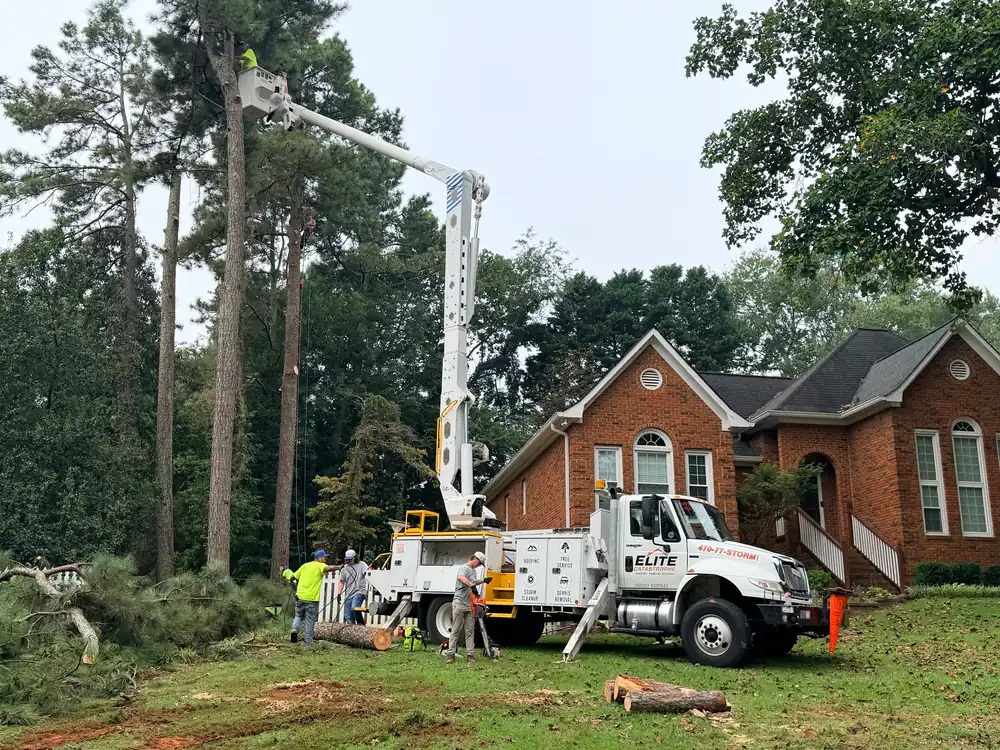
Sixty-plus feet, healthy, but leaning over the kitchen. Nothing free-falls here. A climber takes it down limb by limb, roping each piece to the ground, and the trunk comes down in sections. This is skilled, slow, nothing-left-to-chance work, and it prices in the upper-middle of the spread. The tree's size matters, but the house underneath it is what you are really paying to protect.
The storm-dropped pine on the fence
Already on the ground sounds cheaper, and sometimes it is. But a pine lying across a fence is loaded with tension, and cutting it wrong makes it roll or spring. Storm work also tends to happen when every crew in the county is buried, and urgency is real. Expect fallen tree removal to price by complexity and timing, not by the fact that gravity did the felling. The good news: when a storm put it on a structure, homeowners insurance frequently gets involved.
The dead standing pine
The one the beetles got two summers ago, gray and bare, fifty feet from the house. Despite being the tree everyone expects to be cheap, it often quotes above its healthy twin. Which brings us to the next point.
Why Dead Trees Cost More
A live tree is an engineered structure a climber can trust. Dead wood is the opposite: brittle, unpredictable, and hollow in places you cannot see. Limbs that look solid snap under a rope's load. Trunks that look stout are punky inside. Most crews will not put a climber in a standing dead pine at all, and they are right not to.
That means the tree comes down by bucket truck, by crane, or by rigging from neighboring trees, all of which take more equipment, more setup, and more time. It is the polite explanation behind an estimate that feels high for a tree that is already dead: the crew is pricing the danger, not the diameter. It is also the argument for removing a dying tree sooner rather than later. The longer it stands, the more dangerous and expensive it gets.
The Stump Is Its Own Line Item
Standard removal typically leaves a stump cut low to the ground. Grinding it out is an add-on, commonly somewhere around $100 to $400+ per stump nationally depending on size and access, with the same disclaimer as everything above: ballpark, not a quote. If you plan to replant, resod, or mow over the spot, it is worth doing while the crew is already there. Our stump grinding page covers how the process works and what happens to the grindings.
What a Real Estimate Should Include, and the Red Flags
A trustworthy tree removal estimate is boring in the best way. It is written, it names the tree or trees, and it spells out scope: takedown method, whether wood is hauled or stacked, whether limbs are chipped, whether the stump is included, and how the yard will be protected. When you have that in hand, comparing bids becomes possible.
The red flags are just as recognizable:
- The door knocker. Someone appears uninvited after a storm with a chainsaw in the truck and a today-only price. Reputable crews are busy after storms; they do not need to canvass.
- Cash only, no paperwork. If there is no written scope, there is nothing holding the price or the work in place.
- Nothing to show you. Ask for proof of insurance and references. A professional outfit produces both without blinking. If a tree comes through your roof because of an uncovered crew's mistake, that becomes your problem.
- A price with no visit. Nobody can responsibly quote a big removal from a phone photo. Site conditions are half the job.
None of this is about spending more. It is about making sure the low bid and the high bid are describing the same job.
Getting a Real Number for Your Tree
Ballparks end where your yard begins. If you have a tree you are watching nervously, the useful next step is an on-site look and a written number. Elite Catastrophe quotes tree removal across Rome, Cedartown, Rockmart, and the rest of Northwest Georgia, and an estimate costs you nothing. Request one here or call, and you will trade guessing for a number you can plan around.
Tree Removal Cost Questions, Answered
Broad national ballpark: about $1,500 to $5,000+ for large trees, with height, condition, and proximity to structures deciding where a given tree lands. These are industry ballparks, not quotes; every job differs, so get an on-site estimate.
Usually only when a storm dropped the tree onto a covered structure such as the house, garage, or fence. A standing tree, even a dead one, is normally considered maintenance and comes out of pocket, which is one more reason not to wait on a declining tree.
Typically no. Dead wood cannot be climbed safely, so crews bring bucket trucks, cranes, or heavy rigging instead, and the price reflects that equipment and risk. The earlier a dying tree comes down, the simpler and cheaper the job tends to be.