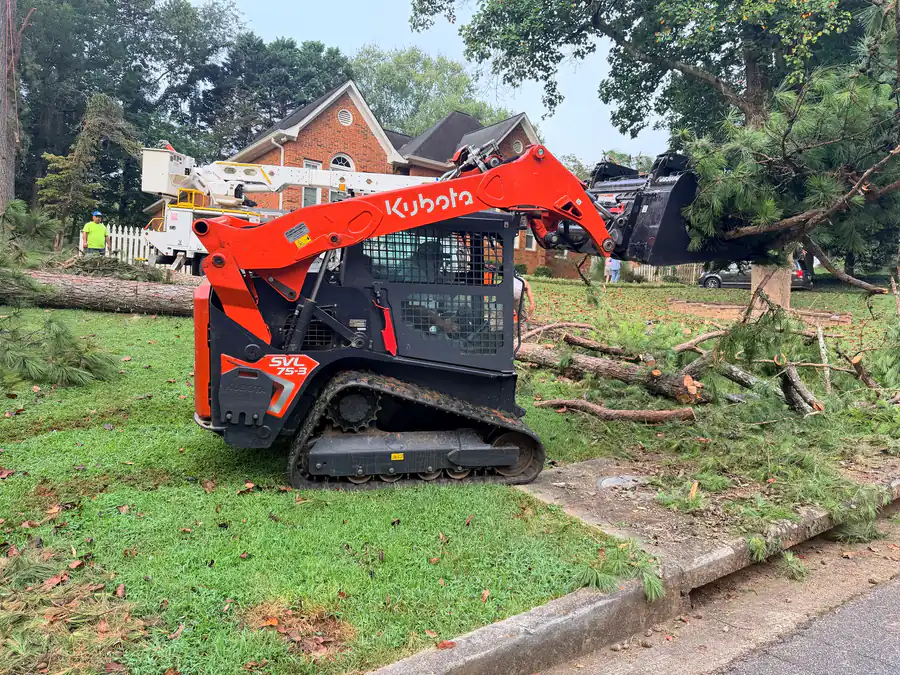
Somewhere in your yard there may be a tree that quietly outgrew every plan anyone ever had for it. An 80 foot pine hanging over the back bedroom. A dead oak the storms have been working on for two years. At some point the question stops being whether it should come down and becomes how, and that is where the job changes character completely.
Taking down big or dangerous trees is a different trade from ordinary tree work. This post explains what makes a removal large, what makes one hazardous, why a crane sometimes earns its place on the invoice, and what the industry generally charges, so you can read any quote without guessing.
What makes a removal "large"
Size is more than height, though height matters. A few things push a removal into the large category:
- Height and diameter. Once a tree passes roughly 60 feet, or the trunk gets wider than two hands can span, every cut moves serious weight. A single log section from a mature pine can weigh as much as a small car, and it has to go exactly where the crew intends, every time.
- Lean. A tree that leans has already decided where it wants to go. Working against a lean takes rigging, tension, and experience reading how wood fiber behaves under load.
- What sits underneath. Arborists call these targets: the house, the garage, the fence, the septic tank, the neighbor's trampoline. A 70 foot tree in an open pasture is a chainsaw job. The same tree standing between two houses is closer to an engineering job.
What makes a tree hazardous
Hazardous is not a scare word. In the trade it means the tree has a defect that makes failure likely, plus a target it can reach when it fails. Around Northwest Georgia the usual suspects are:
- Dead standing pines. Pines die fast, often from beetles, and dead pine turns brittle in months, not years. A dead pine will not bend in the wind. It snaps.
- Storm-cracked trunks and hangers. A tree that took wind damage can look fine from the ground while a crack runs halfway through the stem. Broken limbs hung up in the canopy come down whenever they feel like it, which is why crews call them widow-makers.
- Power lines in the canopy. Any tree grown into or over lines adds an electrical hazard on top of the gravity hazard, and parts of the job may need utility coordination before anyone makes a cut.
- Structures underneath. The same defect matters far more when the fall path includes a roof, a bedroom, or a driveway where people walk.
A hazardous tree also changes how a crew is allowed to work. Climbing a dead tree is often unsafe, because dead wood cannot be trusted to hold a climber's weight. That single fact drives many of the decisions that follow, including the biggest one: the crane.
Why a crane changes the job
Traditional removal is a climber taking the tree apart from the top down, roping sections off and swinging them away from targets. It works beautifully on sound trees with room to work. A crane replaces gravity management with lifting.
With a crane on site, the operator picks each section straight up and swings it to the landing zone. Nothing falls, nothing swings over the roof under rope tension, and nobody has to climb wood that cannot be trusted. Cranes earn their cost in three situations:
- Over-house picks. When a tree leans over a structure, sections can be lifted vertically off the top instead of being lowered past the shingles one rope length at a time.
- Tight yards. No drop zone means no conventional felling. A crane can set up in the street or driveway and reach over the house to the tree.
- Dead or compromised trees. If the wood will not safely hold a climber, the crane holds the wood instead, and the crew works from the hook or a lift.
Crane work adds cost, but on the right tree it subtracts more risk than it adds money. It is often faster too: a removal that would take a climbing crew two days can come apart in a morning.
What large tree removal costs
Here is an honest look at the numbers, with the caveat that matters most stated up front: these are national industry ballparks, not quotes, and every job is different. Access, targets, tree condition, and hauling all move the figure, which is why serious companies look at the tree before they price it.
- Small trees under about 30 feet commonly run $300 to $800+.
- Mid-size trees of 30 to 60 feet often land in the $800 to $2,000+ range.
- Large trees, like a 60 to 80 foot pine or a mature oak, frequently run $1,500 to $3,000+.
- Very large, hazardous, or crane-assisted removals typically run $1,500 to $5,000+, and extreme cases go beyond that.
Be careful comparing quotes on price alone. The cheap bid on a hazardous tree is often cheap because it skips the rigging, the extra ground crew, or the crane that make the job safe. Ask any company how they plan to keep sections off your roof, ask what happens to the wood and debris, and ask for proof of insurance and references. A professional outfit will have ready answers for all three.
Why this is not DIY territory
Plenty of homeowners run a chainsaw well, and plenty of small trees are fair game for a capable owner. Large and hazardous trees are a different animal, and the reasons are physics, not gatekeeping.
Wood under load does not behave like wood on a sawhorse. A leaning trunk stores tension on one side and compression on the other, and cutting the wrong side first can split the stem back toward the operator faster than anyone can react. Limbs pinned under a fallen trunk are loaded springs. And height multiplies everything: a mistake at 15 feet is a bad day, while the same mistake at 60 feet, next to a house, is a catastrophe. Emergency rooms see chainsaw and tree-fall injuries every storm season, and many involve homeowners taking on trees beyond their equipment.
A simple rule of thumb: if the tree is big enough to hit something you care about, it is big enough to have a professional look at it first.
When to make the call
Two situations, two speeds. If a tree is standing but worries you, dead, cracked, or leaning harder than it used to, that is a planned tree removal: get an assessment, get a price, and put it on the schedule for a calm day. If a tree has already failed onto a structure, a driveway, or a line, that is emergency tree service, and the call happens now, at any hour.
Elite Catastrophe handles both across Northwest Georgia, from Rome out to Cartersville and the towns between. Request a free estimate and we will look at the tree, explain what it needs in plain language, and tell you honestly if it does not need to come down at all.
Questions we hear about big removals
Industry ballparks for a large tree run roughly $1,500 to $3,000+, and very large or crane-assisted removals commonly run $1,500 to $5,000+. These are national ranges, not quotes, and every job is different. Access, tree condition, nearby structures, and cleanup all move the number, which is why a real price requires a look at the actual tree.
When the tree cannot be safely climbed or dropped: dead or storm-cracked trees, trees leaning over a house, and tight yards with no drop zone. The crane lifts each section straight up instead of lowering it past whatever sits below, which removes most of the ways a removal can go wrong.
Look for the combination of a defect and a target. Dead tops, fungus at the base, a new lean, trunk cracks, or hanging limbs, plus something underneath that the tree can reach when it fails. If both are present, have a professional assess it promptly. If the tree is healthy and nothing sits in its fall path, removal is often unnecessary.