A limb goes through the shingles at 2 a.m., or a gust peels a section of roofing back like a sardine can, and suddenly you are standing in the yard with a flashlight wondering what happens next. Here is the short version: the hole gets covered tonight or first thing tomorrow, and everything else follows from there. That cover is a roof tarp, and how well it goes on has more to do with how the next three months of your life go than almost any other decision you make after the storm.
This guide walks through why tarping comes first, what a proper emergency roof tarp actually looks like, how long it can stay up, how it fits into your insurance claim, and what professional tarping tends to cost.
Why Tarping Is the First Move After Roof Damage
Water damage does not wait politely for adjusters and estimates. Once a roof is open, every hour of rain compounds the problem. Water finds the insulation first, then the drywall, then the flooring below that. A puncture that started as a shingle and decking repair can become a ceiling replacement by the weekend, and a mold remediation project by the end of the month.
That is why every experienced storm crew works the same order of operations: make the structure watertight first, sort out the permanent repair second. A tarp is not a fix. It is a pause button. It stops the damage clock so you can schedule repairs on your timeline instead of the weather's.
What a Proper Roof Tarp Job Looks Like
There is a real difference between a tarp job that survives the next thunderstorm and one that becomes its own leak. If you want to understand how to tarp a roof the way professionals do it, watch for these details:
- Over the ridge, not just over the hole. The tarp should carry up and over the peak of the roof so water cannot run underneath the top edge. A tarp that stops mid-slope is collecting water, not shedding it.
- Battened down, not weighted down. Wood strips, usually furring boards, get rolled into the tarp edges and fastened so the wind has nothing to grab. Loose plastic flaps itself to shreds in a single windy night.
- Generous overlap past the damage. Coverage should extend well beyond the visible damage in every direction, because the decking around a puncture is often compromised further than it looks.
- Smooth and taut. Wrinkles and bellies pond water, and ponded water finds its way through.
Compare that to the classic bedsheet-and-bricks approach: a loose tarp thrown over the hole with cinder blocks or bricks sitting on top. The first strong gust turns those bricks into projectiles sliding down your shingles, the tarp balloons, and the hole is open again by morning. If you see a crew stapling the edges flat to the shingles with nothing rolled into them, that tarp has the same life expectancy.
A proper install is exactly what a dedicated roof tarping crew does day in and day out after storms, and it is worth insisting on.
How Long Can a Tarp Stay on a Roof?
Installed right, a quality tarp typically holds up for several weeks to a few months. Heavy sun is the main enemy, because UV exposure makes the material brittle, and Georgia summers are generous with sun. Wind works on the fasteners, and every rain tests the overlaps.
So the practical answer to how long a tarp can stay on a roof is this: long enough to get through the insurance process and onto a repair schedule, and not a day longer than it has to. A tarp is a bridge, not a roof. The blue tarp roofs you still see in some neighborhoods a year after a storm are not a testament to tarp durability. They are homes where the permanent repair stalled, and most of them are quietly leaking at the edges.
If your timeline is stretching past a couple of months, have someone put eyes back on the tarp. Re-tensioning or re-covering is cheap compared to what a failed tarp lets inside.
Roof Tarping and Your Insurance Company
Here is the part many homeowners do not know until they read their policy in a panic: you have a duty to mitigate. Most homeowner policies require you to take reasonable steps to prevent further damage after a covered event. Tarping is the textbook example. If you leave the roof open for two weeks and the interior damage doubles, the insurer can push back on the portion you could have prevented.
The good news is that the same logic runs in your favor: reasonable emergency tarping costs are commonly covered as part of the claim. A few habits protect you here:
- Photograph everything before the tarp goes on. Wide shots of the roof, close shots of the damage, and interior shots of any leaks. Once the tarp is up, the adjuster cannot see what you saw.
- Keep the invoice. Emergency tarping is a documented mitigation expense. Submit it with the claim.
- Do not authorize permanent repairs yet. Tarp first, let the adjuster inspect, then schedule the real fix.
If the storm did broader damage than the roof, a crew that handles full storm damage restoration can document tree, roof, and structure damage in one pass, which makes the claim file cleaner.
What Professional Emergency Tarping Costs
As a broad national ballpark, professional emergency roof tarping tends to run somewhere around $200 to $1,000+. Small, simple, walkable roofs sit at the low end. Large roofs, steep pitches, multiple damage points, second-story work, and middle-of-the-night response all push the number up, and complex jobs can land above that range. Roof tarp cost is mostly a labor and risk number, not a materials number, which is why the spread is wide.
To be clear about those figures: they are national industry ballparks, not quotes, and every roof and every job differs. The only number that matters for your house is the one a crew gives you after looking at your actual damage. Remember, too, that this expense usually flows into the insurance claim rather than staying out of your pocket.
Why DIY Tarping After a Storm Is How People Get Hurt
Every storm season, emergency rooms fill with homeowners who fell off ladders and roofs trying to save a few hundred dollars. It is worth being blunt about why post-storm roofs are uniquely dangerous, even for people comfortable on a ladder:
- Everything is wet. Wet shingles, wet moss, wet tarps underfoot. Traction you counted on is gone.
- The decking may be punctured where you cannot see it. A limb strike can crack sheathing under shingles that look fine. Step there and your leg goes through.
- The pitch fights you. Hauling and spreading a heavy tarp on a slope, often in wind, takes both hands you would rather have holding something.
- Storms drop lines as well as limbs. Downed or sagging power service around the house adds a hazard no tarp is worth.
Crews that do this work carry harnesses, roof anchors, footwear made for wet slopes, and a second set of hands. The math is simple: the cost of a professional tarp is a fraction of one urgent care visit, let alone a fall.
Who to Call in Northwest Georgia
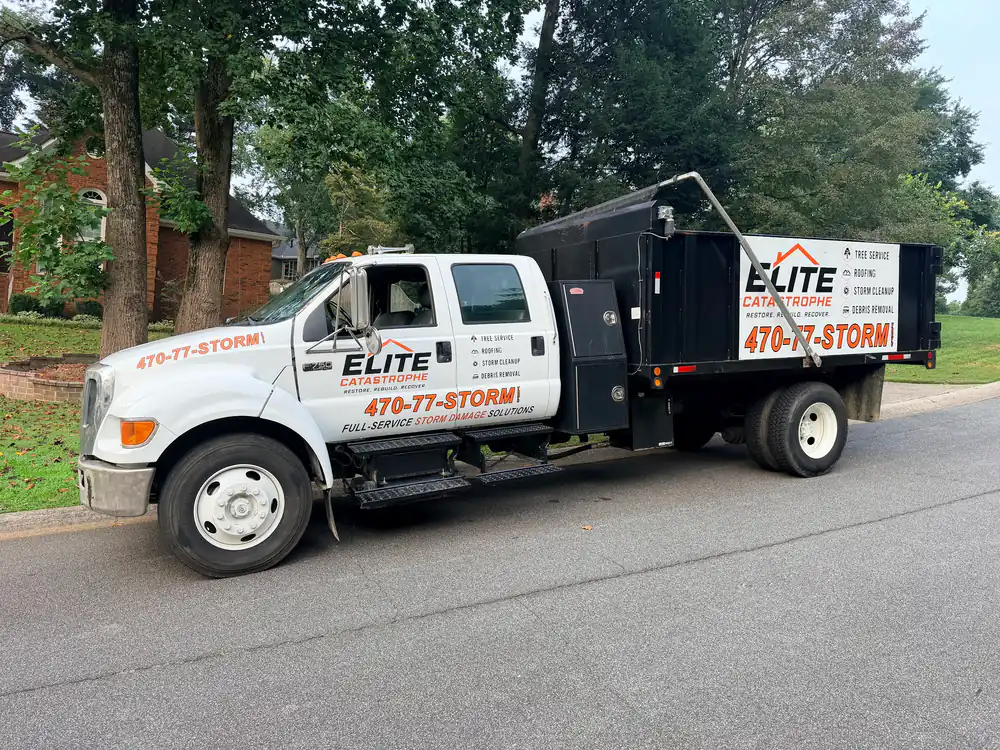
Elite Catastrophe runs storm response out of Rome and works the surrounding Northwest Georgia towns, with the phone answered around the clock during storm events. If a tree put a hole in your roof, one call covers the tree, the tarp, and the documentation your insurer needs. You can also request an estimate online for anything that is not an emergency.
The takeaway is simple. Tarp fast, tarp properly, photograph first, keep the paperwork, and treat the tarp as the bridge it is. Do that, and a bad night stays a bad night instead of becoming a bad season.
Roof Tarping Questions, Answered
Installed correctly, several weeks to a few months. Sun, wind, and rain all wear it down, so treat that window as time to complete the permanent repair, not as a reason to delay it.
Broad national ballpark: about $200 to $1,000+, with large, steep, or complex roofs sometimes higher. Those are industry ballparks rather than quotes, every job differs, and the cost is commonly reimbursable through your storm claim.
Usually, yes. Policies expect you to mitigate further damage, and emergency tarping is the standard way to do it. Photograph the damage before the tarp goes on and submit the tarping invoice with your claim.
You can, but you should not. Wet slopes, hidden punctures, and wind make post-storm roofs dangerous even for confident DIYers. A crew with anchors and proper footwear can have it covered in an hour or two.