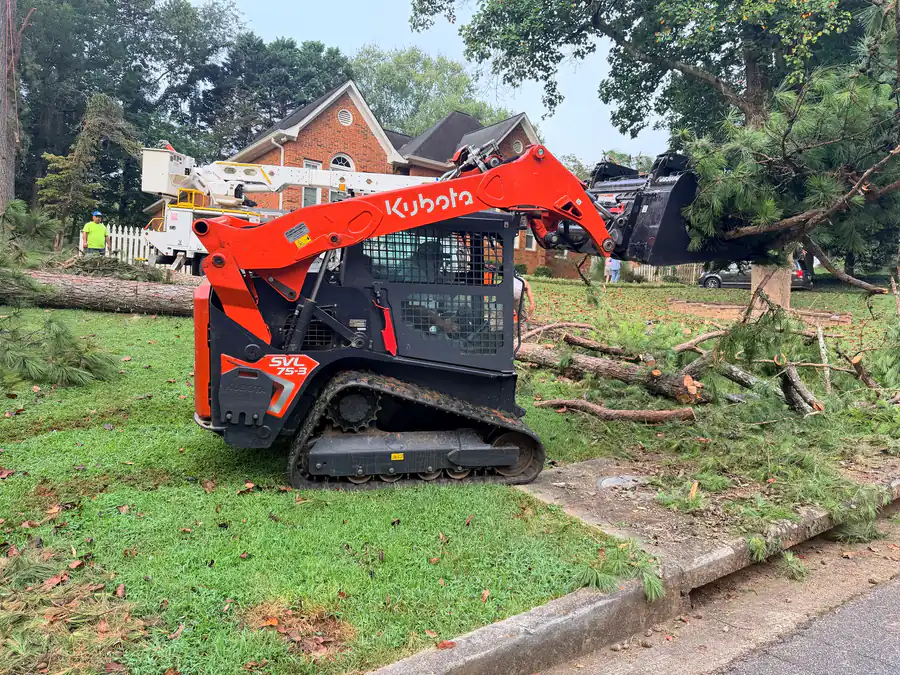
Why do Bradford pears always split?
Because of how they are built, not because of bad luck in a particular storm.
A Bradford pear sends up many limbs from nearly the same point on the trunk, at very tight angles. Where two limbs meet that tightly, bark gets trapped in the joint instead of wood fusing together. That is called included bark, and it is a seam rather than a union.
Then add fast growth and brittle wood. The tree gets big quickly, carries a heavy rounded canopy, and the joints holding it together were never strong to begin with.
So they come apart, usually straight down the middle, and usually in ice or a summer thunderstorm. Fifteen to twenty years is the typical point at which a Bradford pear reaches the size where its own structure fails.
Is the Bradford pear invasive in Georgia?
Yes. Callery pear, which is the species Bradford is a cultivar of, is listed as a Category 1 invasive by the Georgia Exotic Pest Plant Council, meaning it threatens native ecosystems in documented ways.
The mechanism is worth understanding, because the original Bradford was supposed to be sterile. It is self-incompatible, so a lone Bradford cannot set viable seed with itself. Once other Callery cultivars were planted nearby, they cross-pollinated and produced perfectly viable fruit.
Birds take that fruit into fence lines, road edges and untended ground, where the seedlings revert to the rootstock's wild form. Those wild trees are thorny, dense, and very hard to clear once established. If you have driven past a hedgerow in Northwest Georgia covered in white bloom in early spring, that is usually what you are looking at.
Are Bradford pears banned in Georgia?
No, and it is worth being precise about this because the internet gets it wrong constantly.
South Carolina and Ohio have both banned the sale of Callery pear. Georgia has not. Georgia does not have a noxious weed law that prevents the sale of known invasive species, so these trees can still legally be sold in Georgia nurseries.
Invasive and illegal are two different things. Callery pear is clearly the first in Georgia and is not the second. If you see a claim that Georgia banned them in 2024, that is a confusion with the states that did.
Should you remove a Bradford pear?
We would not tell anyone to rush out and cut down a healthy tree. But there are three situations where it is the sensible call.
- It has already split. Once a Bradford pear loses a major limb, the remaining structure is compromised and unbalanced. They rarely recover into anything stable.
- It is fifteen years or older and over something that matters. A car, a roof, a play area, a driveway you park in.
- You can see included bark at the main union. A tight V with bark pressed into the seam, sometimes with a visible crack running down from it, is the failure waiting to happen.
The good news is that these are usually small, quick removals. They are not tall, the wood is light, and the stump is manageable. If one has already come down on something, that is emergency tree service.
Can pruning save one?
Pruning can reduce the load and buy time, and on a younger tree, thinning the canopy and removing the worst competing leaders genuinely helps.
What it cannot do is fix the union. Included bark is a structural defect inside the tree, and no amount of cutting turns a trapped-bark seam into a proper branch attachment.
So on a mature Bradford pear, pruning is risk management rather than a cure. It is worth doing if you want to keep the tree a few more years with your eyes open. It is not worth doing as a way of avoiding an inevitable decision.
What should you plant instead?
UGA Extension recommends native flowering trees that do the same job in a yard without the structural problem or the invasive spread.
- Eastern redbud. Early purple-pink bloom, excellent small yard tree, and native.
- Chickasaw plum. White spring bloom, tough, good for wildlife.
- American fringetree. Unusual white flowers, well suited to this region and underused.
All three flower in roughly the same early spring window that made the Bradford pear popular in the first place, and none of them tears itself in half at twenty years.