Why does everyone in Georgia have these?
Because they grow faster than anything else that stays green all year, and in the 1990s and 2000s every new subdivision in Northwest Georgia wanted a privacy screen by next summer.
Leyland cypress delivered exactly that. Three feet a year, dense to the ground, cheap at the nursery, and evergreen. For about twelve years it is the perfect plant.
The trouble is what happens after year twelve, which is when we start getting the calls.
How big do Leyland cypress actually get?
Far bigger than the space almost anyone plants them in. A mature Leyland cypress in this part of Georgia runs fifty to seventy feet tall and fifteen to twenty feet wide.
Now picture how they were planted. A row along a property line, five or six feet apart, chosen because a six-foot spacing looked right when the trees were four feet tall.
Twenty years later that row is a solid wall of sixty-foot trees whose trunks are nearly touching, each one competing with its neighbors for water and light, and none of them able to grow a proper root system sideways because there is another tree there.
That single decision, made by a builder before anybody moved in, causes most of what follows.
Why is my Leyland cypress turning brown?
There are three common answers and they are not equally serious.
Canker disease. This is the big one in the Southeast. Seiridium canker is the usual culprit, and it typically shows up as one whole branch or a whole section going brown while the rest of the tree still looks healthy. Look along the affected branch for a sunken, darker lesion and often resin bleeding out of it.
Canker is an opportunist. It takes hold in trees already stressed, and in Georgia the stress is almost always drought, crowding, or both. That is why a hot dry August is followed by a lot of brown cypress the next spring.
Needle blight. Fungal needle diseases thrive in the humidity here, especially where trees are packed tightly enough that air never moves through them. This tends to brown the interior and lower branches first.
Normal interior shedding. Not every brown needle is a problem. Conifers drop old interior growth, and a little brown deep inside the canopy while the outer foliage is green is the tree doing what it does.
Will the brown part grow back?
No, and this is the single most important thing to understand about these trees.
Leyland cypress will not push new growth from bare old wood. Once a section has gone brown and dropped its foliage, that section is a permanent hole in the screen.
It is also why a Leyland cypress cannot be cut back hard to control its size. Topping it, or shearing into the brown interior, leaves you with a tree that is both shorter and permanently disfigured, and which now has large wounds for canker to enter. We cover why this matters on any tree on our tree trimming and pruning page.
So the honest options with a badly browned Leyland are narrow. Remove the dead wood and live with the shape, or take the tree out and start over.
Why do whole rows of them go over in a storm?
This is the part that turns a landscaping problem into a roofing problem, and it is why we end up on so many of these.
A Leyland cypress is a sail. It holds dense foliage from the ground to the tip, year round, so a February windstorm loads it exactly as hard as a July one. Most hardwoods are bare in winter and simply do not catch wind the same way.
Underneath, the root plate is shallow and, because of that tight row planting, it never spread properly in the direction it most needed to.
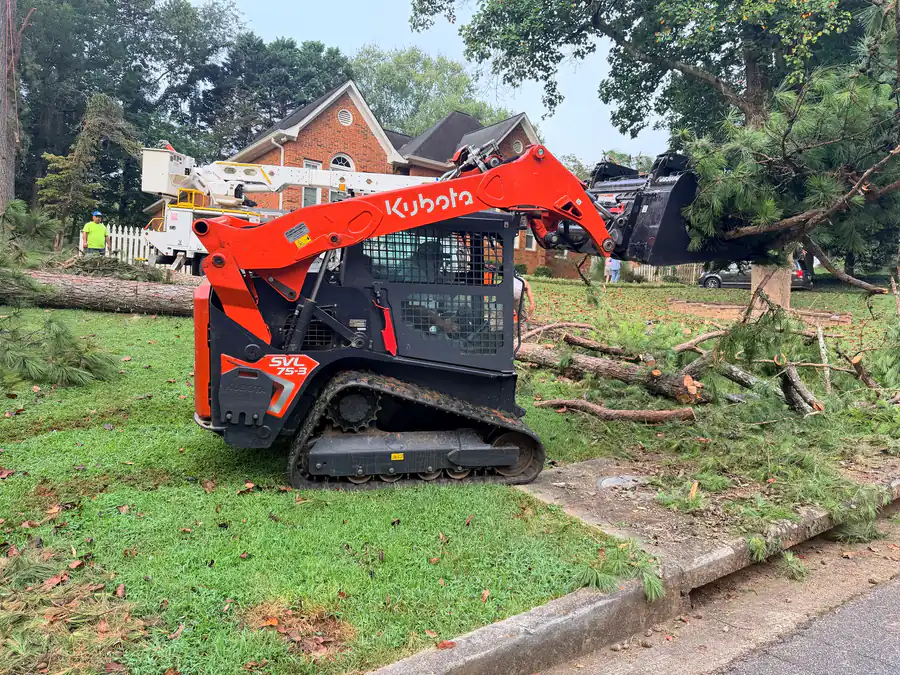
Then there is the row effect. A line of cypress acts as one windbreak, and every tree in it has grown up sheltered by its neighbors. Take out the end tree, or lose one to canker, and the wind gets into the gap. The next one over is suddenly exposed and has no root structure on that side, so it goes too. We have cleared rows where six or seven came down like dominoes in a single night.
If they came down across a roof, that is our storm damage restoration work, and the tree comes off before anything else happens.
When does a Leyland cypress need to come out?
We look at three things, in this order.
- What is underneath it. A sixty-foot cypress leaning toward a bedroom is a different conversation from the same tree at the back of two acres. Target matters more than tree condition.
- How much canopy is gone. Past roughly a third brown, the tree is not recovering its shape and it is carrying dead wood into the next storm.
- Lean and root plate. A fresh lean after a storm, or soil heaving on the uphill side of the root plate, means the tree has already started to fail.
If the answer is removal, the good news is that these come down cleanly. The wood is light, the shape is predictable, and a row job goes faster per tree than the same number of scattered hardwoods. What we usually talk through is whether to take the whole row or just the failures, because a half-removed row has that gap problem all over again.
For what removal generally involves and what drives the number, see our guide to tree removal costs in Georgia.
What should you plant instead?
If you want a screen without repeating the cycle, the usual advice from UGA Extension is to mix species rather than planting a monoculture row, because a single disease cannot take the whole screen out at once.
Eastern red cedar is native, tough, drought-tolerant once established, and does the same job more slowly. American holly and wax myrtle both screen well. If you have the room, a staggered double row of mixed evergreens gives better privacy than a single tight line and lets air move through.
Whatever goes in, the thing worth getting right this time is spacing. Plant for the size the tree actually reaches, not the size it is on the trailer.